Bodega, CA
Conservation and Environmental Stewardship
 Overview
Salmon Creek Ranch encompasses some of the most exquisite scenery and environment in Northern California, with its Redwoods, Creek, natural pasture and forest. Indeed, it is like living in our own National Park! Accordingly we are concerned to be good stewards of our ranch's environment and preserve its natural features for future generations to enjoy. This page details some of our efforts in this regard.
Salmon
Creek
Duckling
Duck Eggs
Goat Meat
Honey
Pet Treats
Back to Home Page
For more information about Salmon Creek Ranch, contact us at: info@salmoncreekranch.com
About a
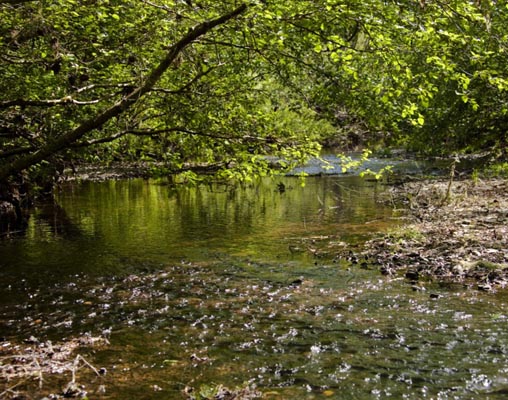
mile and a half of Salmon Creek flows through our ranch, approximately
5% of
the Creek's total 30 mile length. Accordingly, we are concerned to
preserve the creek and its associated riparian habitat. Our section of
the creek is covered with extensive vegitation which we are careful to
perserve. We are aware that some other sections pass through grazed
pasture
that drains directly into the waterway, so we want to make sure that
our
section has sufficient natural
vegetation, fish pools etc so that it
can filter out any adverse effects that may be happening upstream. We
are working with the Natural Resouce Conservation Service (NRCS) to
develop a conservation plan that controls access of livetock to the
creek area and provides alternative water sources for them to eliminate
pollution and erosion of creekside areas. Next time you hear about the
federal "Farm Bill" (famous in the public mind mainly for its pork) be
aware that the NRCS is one of its most important components. Without it
farmers would have greatly diminished incentives and means to protect
environment.
Native Salmon Restoration
 Salmon
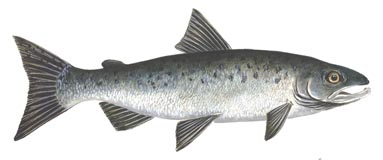
Creek Ranch has been working cloely with the Gold Ridge Conservation
District to help restore the native Coho Salmon in our Creek. We were
excited to learn that they found baby salmon (redds) on our property
this summer
(2009). They transferred some of them to a special nursery area before
re-introducing them to our creek this fall. We plan to continue this
work until the natural fish populations are completely restored.
Salmon
Creek Ranch has been working cloely with the Gold Ridge Conservation
District to help restore the native Coho Salmon in our Creek. We were
excited to learn that they found baby salmon (redds) on our property
this summer
(2009). They transferred some of them to a special nursery area before
re-introducing them to our creek this fall. We plan to continue this
work until the natural fish populations are completely restored.
 Forest
Conservation Plan
Forest
Conservation Plan
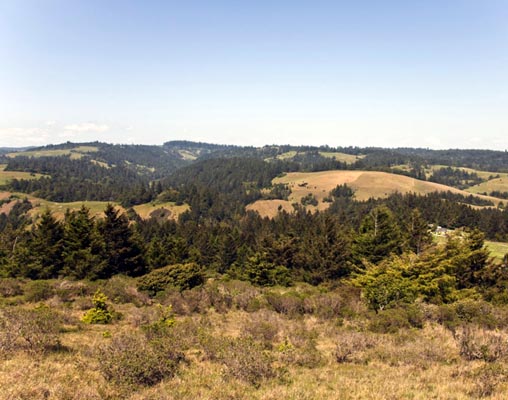
We have been working with the California Department of Forestry and Fire Protection to preserve the ranch's natural forest in a healthy state. Under the CFIP program (California Forest Improvement Program), we have commissioned a forestry study and conservation plan to preserve the best aspects of the natural forest that covers up to a third of the ranch. The forest includes large areas of Douglas Fir, Bay Laurel (also known as Pepperwood or Myrtle), Redwood and other miscellaneous native growths. In recent years natural and human-caused forest fires have been suppressed (see below), and the area, like most of the United States, has been undergoing a steady re-forestation. This has once again modifyed the dynamics between the different forces of nature while serendipitously compensating for about two thirds of America's increase in greenhouse gas emissions. Of course, our own forest is very small in the overall scheme of things, but we aim to nurture its health and biological diversity, while maintaining a balance between forest and pasture that is as close to natural as possible,
 Pasture
Stewardship
Pasture
Stewardship
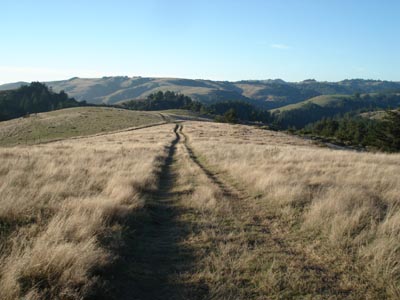
Our pasture at Salmon Creek Ranch is organically certified. This means that no artificial fertilizers or pesticides are used. Some may not realize that organic certification carries steep costs, including substantial fees paid to the certifying organizations (in our case, CCOF), which also require regular on-site inspections (also paid for by the rancher). In addition, all fencing we instal must meet organic standards, avoiding the use of the commonly used long-lasting pressure-treated posts in case the toxic chemicals leach into the soil. Organically certified fencing is much more expensive, and needs replacing more often. However we believe our customers are willing to pay more for their meat knowing that it is not polluted by these toxins.
We are committed to improving our pasture and avoiding overgrazing that can cause long term damage to grasslands. We are working with the Natural Resource Conservation Service (NRCS) to develop rotational grazing strategies that achieve these goals while also reducing the incidence of common livestock diseases.
 Saving
the Bees
Saving
the Bees
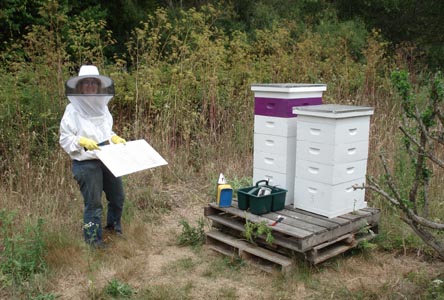
The current mysterious collapse of bee colonies is threatening pollination of crops and oter vegetation in the US. Our understanding of this problem is still in its infancy, since every time the scientists feel they have figured out the cause, deepre study proves that the solution is not so simple. One theory which seems reasonable is that part of the problem is the greater stress most US bees are now under due to their use as commercial crop pollinators which involves moving them around on trucks to orchards where they can only get one kind of pollen. Here atSalmon Creek Ranch our bees live peaceful, undisturbed lives in the meadows by the Creek, enjying the abundant native flowers and the proximity of water in the creek. Since they are never moved, their stress level is as low as it is possible to achieve. We are members of the Sonoma County Beekeepers Association, which is active in the effort to save the country's bee population through the efforts of small scale amateur beekeepers like ourselves.
 Naturally
Raised Livestock
Naturally
Raised Livestock
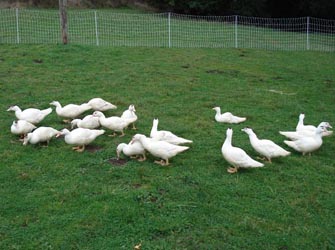
Our philosophy at Salmon Creek Ranch is to raise our animals in a manner that is as close to natural coditions as possible. For example, most of the country's "pasture raised poultry" is actually raised all its life in small portable cages that are periodically moved around the pasture. Our ducks, once they are big enough to survive in the open, are given truly free range in a large pastured area so they can walk, run and fly around in true freedom rather than being cooped up in a cage. A similar philosophy governs our other livestock -- our goats forage freely over hundreds of acres of natural grass and brush every day, with no artificial foods needed or wanted. Goats are closely related to other ruminants such as deer, which have roamed our hills for thousands of years and continue to do so today.
The Birds: Audubon Society Collaboration
We are situated in the area where the classic Hitchcock film "The Birds" was filmed. In 2010 we began working with the Sonoma County branch of the Audubon Society on their annual Christmas Bird Count (CBC), held shortly after the New Year. The visiting birdwatchers were able to identify 37 species of birds at the ranch during a 3 hour period!! The CBC data collected over the past century allow researchers to study the long-term health and status of bird populations across North America. It also helps provide a picture of how the continent's bird populations change over time. The long term perspective made possible by the Christmas Bird Count is vital for informing strategies to protect birds and their habitat - and helps identify environmental issues with implications for people as well.
Wild Animals
We try to manage the ranch so that the wild animals who were here before us and call it home can stay. These include mountain lion,
coyote, deer, bobcat, fox, skunk, badger, raccoon, gopher, mole, rat, field mouse, frog, rabbit (jack and cottontail), snake, lizard. This not an exhaustive list, and within each descriptor there is usualy a whole family of members!
We install wildlife-friendly fencing with large enough gaps at the bottom for all the smaller critters to get through, and low enough for the deer to jump over. This and many other measures ensure that the local wildlife an survie and flourish at Salmon Creek Ranch!
Sustainable Farming
There is a lot said and written these days about "sustainable" agriculture, energy, and living. Unfortunately, relatively few people actually study the underlying science to really understand what is feasible and what is not, and even fewer try to make their living producing energy or food. By definition, sustainable agriculture means using practicies that can be continued indefinitely into the future. In the end, this means our agriculture (like our energy production) has to be profitable and 24/7 reliable as well as preserving the environment.
Here at Salmon Creek Ranch, we attempt to match our livestock management practices to the natural ecology of the area, and produce our products with as small an environmental footprint as possible while devoting significant resources to conservation. This involves considerably more labor and expense than the factory farm approach, so we need enough customers to realize that local, naturally raised food from animals that are naturally raised in their preferred environment is worth a bit more than mass-produced food of questionable factory or overseas origin. If customers instead adopt the Walmart shopping philosophy, buying the lowest priced food they can find, ranches like ours will cease to be "sustainable" and soon be put out of business.
 Preserving
our Historic Heritage
Preserving
our Historic Heritage
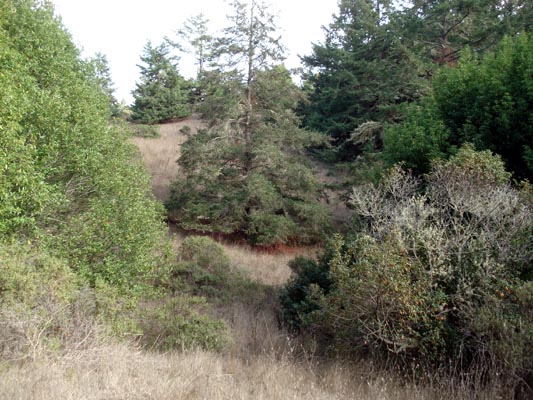
We aim to preserve and improve the historic ecological health and biological diversity of the area in which our ranch is situated. Both prehistoric and modern humans have influenced the environment; we are told the local Indians used to burn off the forest every year to expand the grasslands. This encouraged the deer, mountain lions and smaller animals they hunted and ate along with the large variety of bird life that is sustained by the mixture of trees, pasture, prey and carrion. For the future, we hope to maintain a healthy balance between pasture and forest, protect the salmonid creek, and encourage the native wildlife to coexist with the domesticated livestock. To this end we use special wildlife-friendly fencing, which allows small critters to get through the bottom unimpeded, and large ones (deer etc) to jump over the top.
As a result of these and other conservation initiatives, Salmon Creek Ranch with its numerous foxholes, gopher mounds, vultures, deer, and skunks may not look as tidy and manicured as some farms. But we think the effort and money we spend on preserving our unique natural habitat is a worthwhile investment in the future. We plan to pass on this land in a better condition than we found it, and we hope that enough customers will recognize the value in these efforts to make up for the extra costs we incur in the process.
Quick
Links to Salmon
Creek Ranch ProductsNative Salmon Restoration
Salmon
Creek Ranch has been working cloely with the Gold Ridge Conservation
District to help restore the native Coho Salmon in our Creek. We were
excited to learn that they found baby salmon (redds) on our property
this summer
(2009). They transferred some of them to a special nursery area before
re-introducing them to our creek this fall. We plan to continue this
work until the natural fish populations are completely restored. Forest
Conservation PlanWe have been working with the California Department of Forestry and Fire Protection to preserve the ranch's natural forest in a healthy state. Under the CFIP program (California Forest Improvement Program), we have commissioned a forestry study and conservation plan to preserve the best aspects of the natural forest that covers up to a third of the ranch. The forest includes large areas of Douglas Fir, Bay Laurel (also known as Pepperwood or Myrtle), Redwood and other miscellaneous native growths. In recent years natural and human-caused forest fires have been suppressed (see below), and the area, like most of the United States, has been undergoing a steady re-forestation. This has once again modifyed the dynamics between the different forces of nature while serendipitously compensating for about two thirds of America's increase in greenhouse gas emissions. Of course, our own forest is very small in the overall scheme of things, but we aim to nurture its health and biological diversity, while maintaining a balance between forest and pasture that is as close to natural as possible,
Pasture
StewardshipOur pasture at Salmon Creek Ranch is organically certified. This means that no artificial fertilizers or pesticides are used. Some may not realize that organic certification carries steep costs, including substantial fees paid to the certifying organizations (in our case, CCOF), which also require regular on-site inspections (also paid for by the rancher). In addition, all fencing we instal must meet organic standards, avoiding the use of the commonly used long-lasting pressure-treated posts in case the toxic chemicals leach into the soil. Organically certified fencing is much more expensive, and needs replacing more often. However we believe our customers are willing to pay more for their meat knowing that it is not polluted by these toxins.
We are committed to improving our pasture and avoiding overgrazing that can cause long term damage to grasslands. We are working with the Natural Resource Conservation Service (NRCS) to develop rotational grazing strategies that achieve these goals while also reducing the incidence of common livestock diseases.
Saving
the BeesThe current mysterious collapse of bee colonies is threatening pollination of crops and oter vegetation in the US. Our understanding of this problem is still in its infancy, since every time the scientists feel they have figured out the cause, deepre study proves that the solution is not so simple. One theory which seems reasonable is that part of the problem is the greater stress most US bees are now under due to their use as commercial crop pollinators which involves moving them around on trucks to orchards where they can only get one kind of pollen. Here atSalmon Creek Ranch our bees live peaceful, undisturbed lives in the meadows by the Creek, enjying the abundant native flowers and the proximity of water in the creek. Since they are never moved, their stress level is as low as it is possible to achieve. We are members of the Sonoma County Beekeepers Association, which is active in the effort to save the country's bee population through the efforts of small scale amateur beekeepers like ourselves.
Naturally
Raised LivestockOur philosophy at Salmon Creek Ranch is to raise our animals in a manner that is as close to natural coditions as possible. For example, most of the country's "pasture raised poultry" is actually raised all its life in small portable cages that are periodically moved around the pasture. Our ducks, once they are big enough to survive in the open, are given truly free range in a large pastured area so they can walk, run and fly around in true freedom rather than being cooped up in a cage. A similar philosophy governs our other livestock -- our goats forage freely over hundreds of acres of natural grass and brush every day, with no artificial foods needed or wanted. Goats are closely related to other ruminants such as deer, which have roamed our hills for thousands of years and continue to do so today.
The Birds: Audubon Society Collaboration
We are situated in the area where the classic Hitchcock film "The Birds" was filmed. In 2010 we began working with the Sonoma County branch of the Audubon Society on their annual Christmas Bird Count (CBC), held shortly after the New Year. The visiting birdwatchers were able to identify 37 species of birds at the ranch during a 3 hour period!! The CBC data collected over the past century allow researchers to study the long-term health and status of bird populations across North America. It also helps provide a picture of how the continent's bird populations change over time. The long term perspective made possible by the Christmas Bird Count is vital for informing strategies to protect birds and their habitat - and helps identify environmental issues with implications for people as well.
Wild Animals
We try to manage the ranch so that the wild animals who were here before us and call it home can stay. These include mountain lion,
coyote, deer, bobcat, fox, skunk, badger, raccoon, gopher, mole, rat, field mouse, frog, rabbit (jack and cottontail), snake, lizard. This not an exhaustive list, and within each descriptor there is usualy a whole family of members!
We install wildlife-friendly fencing with large enough gaps at the bottom for all the smaller critters to get through, and low enough for the deer to jump over. This and many other measures ensure that the local wildlife an survie and flourish at Salmon Creek Ranch!
Sustainable Farming
There is a lot said and written these days about "sustainable" agriculture, energy, and living. Unfortunately, relatively few people actually study the underlying science to really understand what is feasible and what is not, and even fewer try to make their living producing energy or food. By definition, sustainable agriculture means using practicies that can be continued indefinitely into the future. In the end, this means our agriculture (like our energy production) has to be profitable and 24/7 reliable as well as preserving the environment.
Here at Salmon Creek Ranch, we attempt to match our livestock management practices to the natural ecology of the area, and produce our products with as small an environmental footprint as possible while devoting significant resources to conservation. This involves considerably more labor and expense than the factory farm approach, so we need enough customers to realize that local, naturally raised food from animals that are naturally raised in their preferred environment is worth a bit more than mass-produced food of questionable factory or overseas origin. If customers instead adopt the Walmart shopping philosophy, buying the lowest priced food they can find, ranches like ours will cease to be "sustainable" and soon be put out of business.
Preserving
our Historic HeritageWe aim to preserve and improve the historic ecological health and biological diversity of the area in which our ranch is situated. Both prehistoric and modern humans have influenced the environment; we are told the local Indians used to burn off the forest every year to expand the grasslands. This encouraged the deer, mountain lions and smaller animals they hunted and ate along with the large variety of bird life that is sustained by the mixture of trees, pasture, prey and carrion. For the future, we hope to maintain a healthy balance between pasture and forest, protect the salmonid creek, and encourage the native wildlife to coexist with the domesticated livestock. To this end we use special wildlife-friendly fencing, which allows small critters to get through the bottom unimpeded, and large ones (deer etc) to jump over the top.
As a result of these and other conservation initiatives, Salmon Creek Ranch with its numerous foxholes, gopher mounds, vultures, deer, and skunks may not look as tidy and manicured as some farms. But we think the effort and money we spend on preserving our unique natural habitat is a worthwhile investment in the future. We plan to pass on this land in a better condition than we found it, and we hope that enough customers will recognize the value in these efforts to make up for the extra costs we incur in the process.
Duckling
Duck Eggs
Goat Meat
Honey
Pet Treats
Back to Home Page
For more information about Salmon Creek Ranch, contact us at: info@salmoncreekranch.com